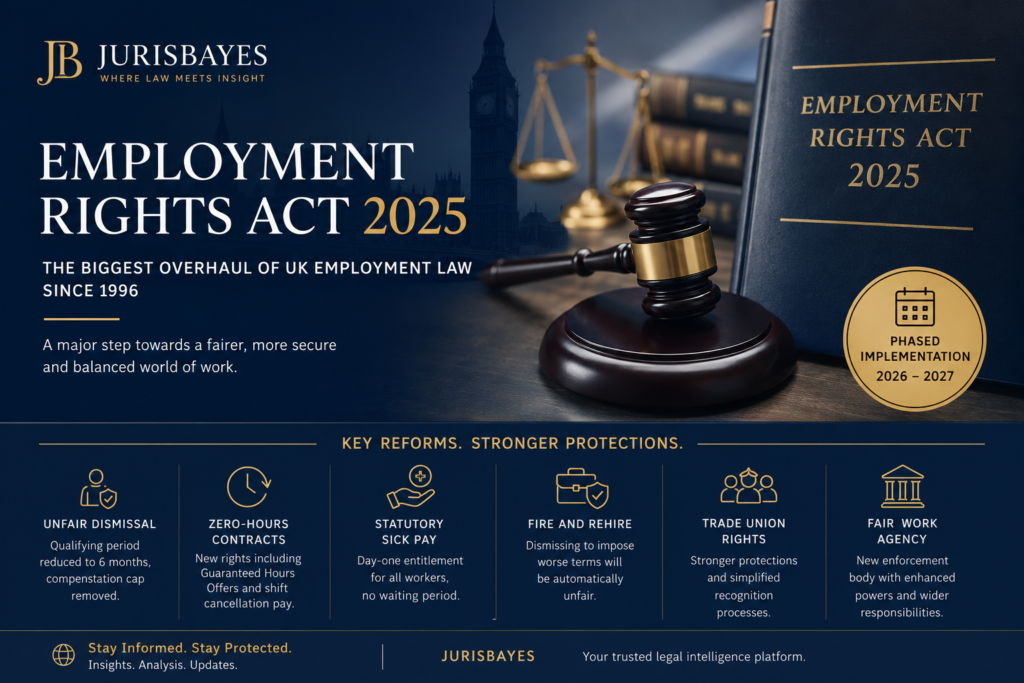
The Employment Rights Act 2025 (ERA 2025) received Royal Assent on 18 December 2025, confirming the statutory framework for one of the most consequential packages of employment law reform in recent history. The Act amends the Employment Rights Act 1996 and introduces phased reforms across unfair dismissal, zero-hours contracts, statutory sick pay, fire and rehire, and trade union rights. It applies across England, Scotland, and Wales. This analysis examines the principal provisions of the Employment Rights Act 2025 and their practical implications for employers, workers, and legal practitioners.
Royal Assent provides certainty as to the content of the reforms. It does not, however, mean that new rights and obligations apply immediately. The government will commence most provisions in phases during 2026 and 2027, setting out further detail through secondary legislation and statutory guidance. For employers, the emphasis now shifts from legislative monitoring to practical preparation.
1. Unfair Dismissal — Qualifying Period Reduced to Six Months
The qualifying period for ordinary unfair dismissal claims will reduce from two years to six months, effective 1 January 2027. The government will also remove the statutory cap on unfair dismissal compensation on the same date, materially increasing financial exposure for employers — particularly in respect of senior employees and those in regulated sectors.
The removal of the compensation cap was a controversial last-minute measure introduced as the Bill progressed through Parliament. It represents a fundamental shift in the litigation risk landscape.
It is equally important to note what the Employment Rights Act 2025 does not do. The original proposal for day-one unfair dismissal protection was abandoned following significant resistance during parliamentary scrutiny. The six-month qualifying period is a compromise position reached after extensive debate in both chambers.
The government will also extend the tribunal time limit for bringing unfair dismissal claims from three months to six months, effective 1 January 2027.
Practical implication: Employers must restructure probationary period policies before January 2027. A six-month qualifying window is considerably shorter than the two years most HR and legal teams have historically operated within. Dismissal procedures and performance management frameworks require immediate review.
2. Zero-Hours Contracts — Guaranteed Hours and Shift Notice
The Act addresses what the Government described as “one-sided flexibility” in zero-hours and low-hours arrangements. The government continues to consult on detailed regulations, with rights expected to take effect from October 2026 onwards.
The core obligations are as follows:
Guaranteed Hours Offers (GHOs): Employers must offer guaranteed hours to workers whose actual hours regularly exceed contracted minimums over a reference period, likely 12 weeks. Dismissal where the principal reason is a worker’s acceptance or rejection of a GHO will be automatically unfair.
Shift notice and cancellation pay: Employers must provide reasonable advance notice of shifts outside agreed patterns. Workers are entitled to compensation where employers cancel shifts at short notice.
Agency workers: These obligations extend to end-user businesses using agency staff, significantly altering the traditional tripartite agency worker relationship and placing direct obligations on businesses that have historically relied on contractual distance from agency workers.
Practical implication: Employers relying on zero-hours workforces must begin building data tracking systems now to monitor actual hours against contracted minimums in preparation for GHO obligations.
3. Statutory Sick Pay — Day-One Entitlement
From 2026, all eligible workers gain a day-one right to Statutory Sick Pay (SSP). The three-day waiting period is abolished. The Lower Earnings Limit threshold — which previously excluded the lowest-paid workers from eligibility — is also removed.
Workers earning below the lower earnings limit will receive SSP at 80% of their average weekly earnings. Those above will continue to receive the existing flat rate, currently £118.75 per week.
This is one of the provisions with an early confirmed implementation date and represents the most meaningful expansion of the SSP regime since its introduction.
4. Fire and Rehire — Automatic Unfair Dismissal
Under the ERA 2025, where an employer dismisses an employee principally because they refused to accept a proposed variation to their contract, that dismissal will be automatically unfair. A narrow exception exists in cases of genuine extreme financial distress, though the courts will construe this threshold deliberately high.
This provision builds on the statutory Code of Practice on Dismissal and Re-engagement that came into force in July 2024, which already prescribed fire and rehire as a last resort following meaningful consultation. The Code remains in force, with amendments to reflect the new statutory framework.
Practical implication: Employers seeking to vary contractual terms must pursue genuine consultation and explore all alternatives before any dismissal. Legal advisers should not rely on the financial distress exception without specific and detailed analysis of the client’s circumstances.
5. Trade Union Rights and the Fair Work Agency
From 18 February 2026 — two months after Royal Assent — dismissal for participating in protected industrial action became automatically unfair, with the previous 12-week limit on protection removed entirely. The government abolished the minimum service levels regime introduced under the previous administration, and streamlined union recognition processes.
A new Fair Work Agency (FWA) will consolidate enforcement of minimum wage, sick pay, holiday pay, and modern slavery obligations into a single body with enhanced inspection powers. This represents a significant structural shift in how employment rights enforcement operates in Great Britain.
Implementation Timeline
| Reform | Commencement |
|---|---|
| Industrial action dismissal protections | 18 February 2026 |
| SSP day-one entitlement | Phased 2026 |
| Zero-hours guaranteed hours rights | October 2026 onwards |
| Unfair dismissal qualifying period (6 months) | 1 January 2027 |
| Removal of unfair dismissal compensation cap | 1 January 2027 |
| Extended tribunal time limit (6 months) | 1 January 2027 |
| Fire and rehire automatic unfair dismissal | 2027 |
What This Means in Practice
For employers, three areas demand immediate attention. Probationary period policies must operate within a six-month window. Employers must systematically track zero-hours workforce data before GHO obligations take effect. And legal teams must review dismissal procedures across all categories in light of significantly expanded automatic unfair dismissal provisions. The Employment Rights Act 2025 represents a generational shift in the balance of power between workers and employers in Great Britain.
For workers, the Act delivers tangible and meaningful gains — particularly for those in insecure employment. Day-one SSP entitlement, guaranteed hours rights, and stronger protection against dismissal collectively strengthen the floor of employment rights in Great Britain.
For legal practitioners, the removal of the unfair dismissal compensation cap is the single most consequential development. Settlement negotiations in high-value cases now proceed against a fundamentally different risk backdrop. The cap — previously set at £115,115 — no longer constrains tribunal awards, and practitioners must reflect this in advice to employer clients.
Frequently Asked Questions
Does the Employment Rights Act 2025 create a day-one right to unfair dismissal protection?
No. The final Act sets a six-month qualifying period from 1 January 2027. The original day-one proposal was abandoned following parliamentary resistance and replaced with the current compromise position.
Does the Act apply in Northern Ireland?
No. Employment law is a devolved matter. The ERA 2025 covers England, Scotland, and Wales only.
Will all unfair dismissal awards become large payouts?
Most tribunal awards will remain modest — the median award has historically been under £7,000. However, for senior employees and high earners, the removal of the compensatory cap fundamentally changes the litigation risk landscape for employers.
Recommended Sources
Employment Rights Act 2025 (c.36): legislation.gov.uk
UK Parliament Bills — Employment Rights Act 2025: bills.parliament.uk
Recommended Books
A Practical Guide to the Employments Rights Act 2025
The Essential UK Employment Law Handbook 2026
For more such work, support below.

Subscribe to our newsletter!